


Tip of the Day | Thursday 29 October 2026
Discover new tools to get things done.
Remove All Numbers (0-9)
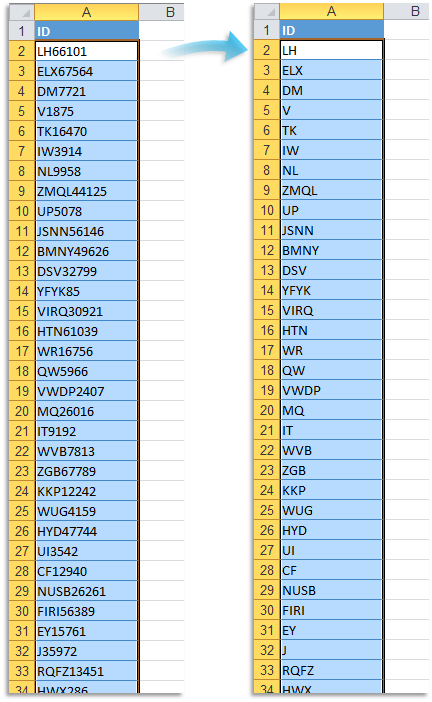
This tool removes all digits (0 through 9) from the values in your selected cells.
It works on plain text and is useful for cleaning up postal codes, employee IDs, product labels, or imported datasets that combine numbers with descriptive text.
For example:
- "75008 Paris" becomes " Paris"
- "325579 Jane Doe" becomes " Jane Doe"
- "804 Robson Street" becomes " Robson Street"
- "Invoice_1003" becomes "Invoice_"
- "Order #4567" becomes "Order #"
Cells that contain formulas or numeric values, such as numbers and dates, are left unchanged.
Note:
This tool only removes digits 0-9. It does not remove punctuation or symbols like decimal points, commas, or minus signs.
For example:
- "An average of 12.50" becomes "An average of ."
Tip:
If needed, you can use our "Remove Leading and Trailing Spaces" tool to clean up any leftover spaces.
Starting this tool
Specify a Keyboard Shortcut: ASAP Utilities › My Tools & Shortcuts › Manage My Tools & Shortcuts...
Tip:Alt+P for the previous tool.